Why Reality TV Confessionals Feel Fake and Staged
Reality TV confessionals have gotten complicated with all the manufactured authenticity flying around. I spent the last three years watching reality television with the same intensity most people reserve for their actual lives — not by choice, exactly, but because I was working on a podcast about media manipulation. That meant dissecting hundreds of hours of confessional footage from The Bachelor, Survivor, and the Real Housewives franchises. What I discovered was unsettling: nearly every confessional interview feels manufactured because, well, nearly every one is. The difference between a genuine emotional moment and a reality TV confession is the difference between a real conversation and a theatrical performance directed by someone holding a clipboard.
But what is a reality TV confessional? In essence, it’s a contestant speaking directly to camera about their experiences on a show. But it’s much more than that. They’re engineered. Not by accident. By design. The smile that seems plastered on. The pause before the punchline. The way contestants’ eyes drift toward an off-camera producer instead of holding steady with the camera lens. These aren’t glitches in the system. They’re the system itself.
The Forced Smile Test—How to Spot a Scripted Confession
There’s a specific moment I started noticing once I knew what to look for. A contestant launches into what should be an emotional revelation, but their face doesn’t match their words. The smile lands wrong. It comes too early. It lingers too long. It’s exactly the kind of smile you make when someone tells you to “look natural,” which, paradoxically, makes you look completely unnatural.
Genuine emotional reactions don’t come with buffer time. When someone is truly upset or excited, the feeling floods their face immediately. The eyes narrow or widen. The corners of the mouth shift involuntarily. A real confession about heartbreak doesn’t start with someone holding a perfectly composed expression for three seconds before delivering the news.
Probably should have opened with this section, honestly — it’s the easiest way to separate authentic from staged. Watch where the contestant’s eyes go when they pause mid-sentence. In a genuine conversation, people look away to retrieve a memory or emotion. In a pre-written confession, they look toward the producer. They’re checking. Did I nail that line? Do you want me to go again?
The timing of jokes is another dead giveaway. I watched a Love Island confessional where someone delivered a quip about their relationship, then immediately paused — a full second of dead air — before the next thought. In real speech, that doesn’t happen. We stumble over our words. We interrupt ourselves. We spit out multiple thoughts rapidly when we’re being spontaneous. Confessionals with spaced-out comedic beats read like someone performed a script they’d rehearsed four times that morning.
Watch the eye contact. Actors and trained speakers maintain steady camera contact. Real people doing genuine confessions let their focus drift. They look down. They look away. They blink more frequently when processing emotion. A contestant maintaining unbroken, confident eye contact while discussing something supposedly shocking? They’ve done this take before. That’s what makes this detail endearing to us as viewers — we recognize the performance because we’ve seen real human behavior.
Three-Light Setup and Why It Makes Confessionals Look Sterile
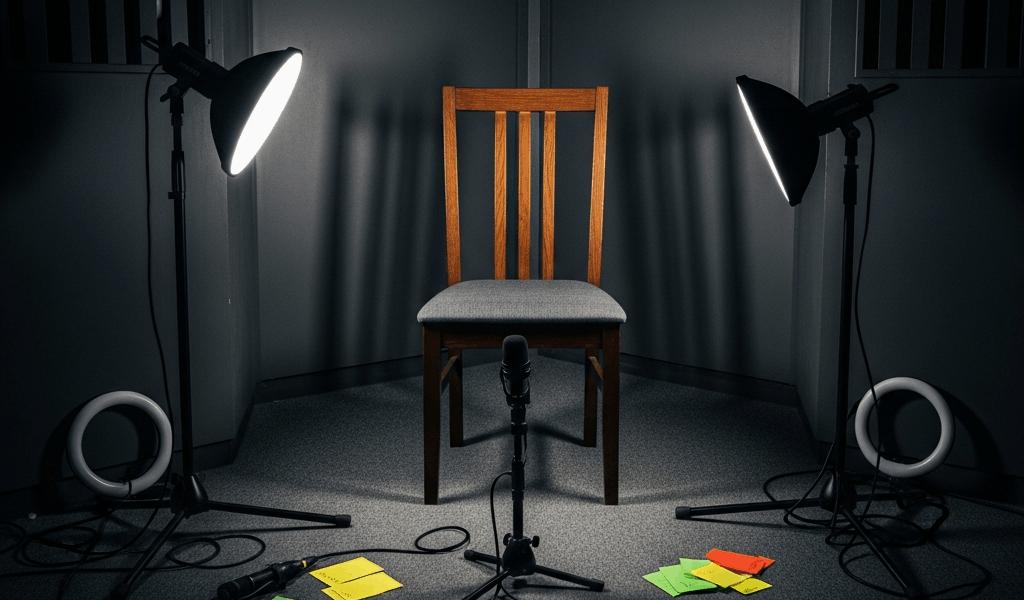
The moment I walked into a television studio, I understood why confessionals look so aggressively fake. Every reality TV production uses the same three-light setup: a key light hitting the subject directly, a fill light softening shadows on the other side, and a back light separating the subject from the background. It’s the gold standard in professional lighting. It’s also completely unnatural.
This setup creates a hyper-polished, studio-quality appearance. The contestant’s face is evenly lit from multiple angles. There are no harsh shadows. No unflattering angles. No texture. The image has the plastic perfection of a professional headshot — which is exactly the problem. Human faces don’t look like that in real life.
Compare this to a documentary-style reality show that uses natural or minimalist lighting. A confession filmed by a window, with actual sunlight creating real shadows? It immediately feels more authentic. Uneven lighting paradoxically reads as more truthful because it matches how we actually see people.
Then there’s the backdrop. Most reality TV confessionals use a blurred or monochrome background — sometimes a bright neon wall, sometimes just a solid color. This artificial environment removes any real-world context. The contestant exists in a vacuum. A void. They’re not in their home or an actual location. They’re in a production booth. The studio lights hum softly. The air feels recycled.
I spent two hours in a reality TV makeup chair once. The artist used about four times the makeup that made sense for actual footage — heavy foundation, defined contours, structured eyeshadow, perfectly lined lips. This isn’t how people look at home. It’s how people look when they’ve been prepared for the camera. The face itself becomes a costume.
The Producer’s Prompt—Why Contestants Say the Same Thing
Here’s what happens off-camera: A producer stands beside the camera operator with a clipboard full of questions. Some are open-ended. Most are leading. They ask things like, “Tell us how you felt when [event] happened,” or “Walk us through what you were thinking,” or my personal favorite, “Tell us you’re falling in love.” That last one isn’t a question at all. It’s a directive wrapped in politeness.
Contestants don’t naturally gravitate toward identical phrasing across episodes unless someone fed them the words. I watched four different people on The Real Housewives of Beverly Hills use the exact phrase “I’m not going to stand here and be disrespected” in completely separate confessionals about unrelated situations. That’s not coincidence. That’s a producer-approved soundbite.
On Survivor, every contestant talks about “making a big move” or “playing the game.” These aren’t phrases that emerge organically from long-term exposure to a show. They’re the vocabulary that producers have trained into the franchise. Over twenty-plus seasons, the language calcifies. New contestants absorb the approved dialect from watching previous episodes, then the producers reinforce it in the booth by asking questions that elicit those specific responses.
The producer off-camera isn’t just recording. They’re also reacting. A good confessional elicits a laugh or a gasp from the production crew. Contestants feel that reaction and adjust. They dial up the emotion or add an extra comedic beat because they know it landed. The confession becomes a performance with a live audience — just not an audience the viewers ever see.
Why Multiple Takes Destroy Spontaneity
Reality TV confessionals are almost never filmed in one take. The standard is three to five takes per confession. I spoke with a production assistant who said they sometimes did seven or eight takes because a producer wasn’t satisfied with the energy level.
The first take always feels different. The contestant is nervous. Adrenaline is flowing. There’s genuine uncertainty about whether they’ll nail it. The words come out slightly rushed or fragmented. There’s real energy, even if the execution is imperfect. By the second take, they’ve calmed down. By the third, they’re thinking about technique. By the fifth, they’re exhausted and running on muscle memory.
A fifth-take confession lacks the spontaneity of moment one. The energy is flatter. The contestant knows exactly where the punchlines are because they’ve delivered them four times already. The surprise is gone. The authenticity is gone. What remains is a polished, technically competent performance from someone who has practiced this emotion the same way an actor rehearses a scene.
Directors specifically ask for retakes when a confession isn’t “big enough” — too quiet, too measured, not enough personality. So the contestant dials it up. Second take is bigger. Third take is exaggerated. By the fifth take, they’ve overcorrected entirely. The emotion is theatrical. That’s what makes this process so endearing to producers, though not so much to viewers who want authenticity.
How to Tell If a Confession Is Actually Live vs. Heavily Produced
Spot authenticity by listening for background noise. Genuine confessions might have ambient sound — a fan humming, traffic outside, birds. A sterile confessional with absolutely no background noise was likely recorded in a sound-dampened booth.
Watch the contestant’s energy level relative to the situation. If someone is describing a devastating argument, do they look energized or drained? Authentic emotional confessions leave people looking visibly affected — quieter, slower, more withdrawn. A confessional where someone bounces back immediately to normal energy levels might have been filmed hours after the event, when the emotion had already faded.
Notice the eye movement pattern. During a real confessional, eyes move naturally — up and left when retrieving memory, down when processing emotion. Static, forward-facing eye contact suggests either a practiced delivery or someone deliberately holding a composed expression for the camera.
Listen for response to off-camera reactions. When a producer laughs or reacts audibly, do you see the contestant’s face shift in real time, or does the confession stay locked in its current emotional register? Real response to off-camera laughter is involuntary. It happens instantly. A confession that continues unaffected suggests a heavy editing situation or a contestant focused solely on hitting their marks.
Check the mouth-to-thought ratio. In genuine speech, we pause, we stutter, we circle back. A confession that flows too smoothly — with paragraphs of uninterrupted monologue and zero verbal filler — was likely heavily scripted or re-recorded until it reached that level of polish. Humans aren’t that articulate in unplanned conversations.
Once you see these patterns, you can’t unsee them. Every reality TV confessional becomes a puzzle where you’re tracking the production seams. Don’t make my mistake — watch a few confessionals knowing this information, and you’ll never experience them the same way again. It doesn’t ruin the shows entirely, but it does change the watching experience. You’re no longer consuming emotion. You’re watching construction.



Leave a Reply